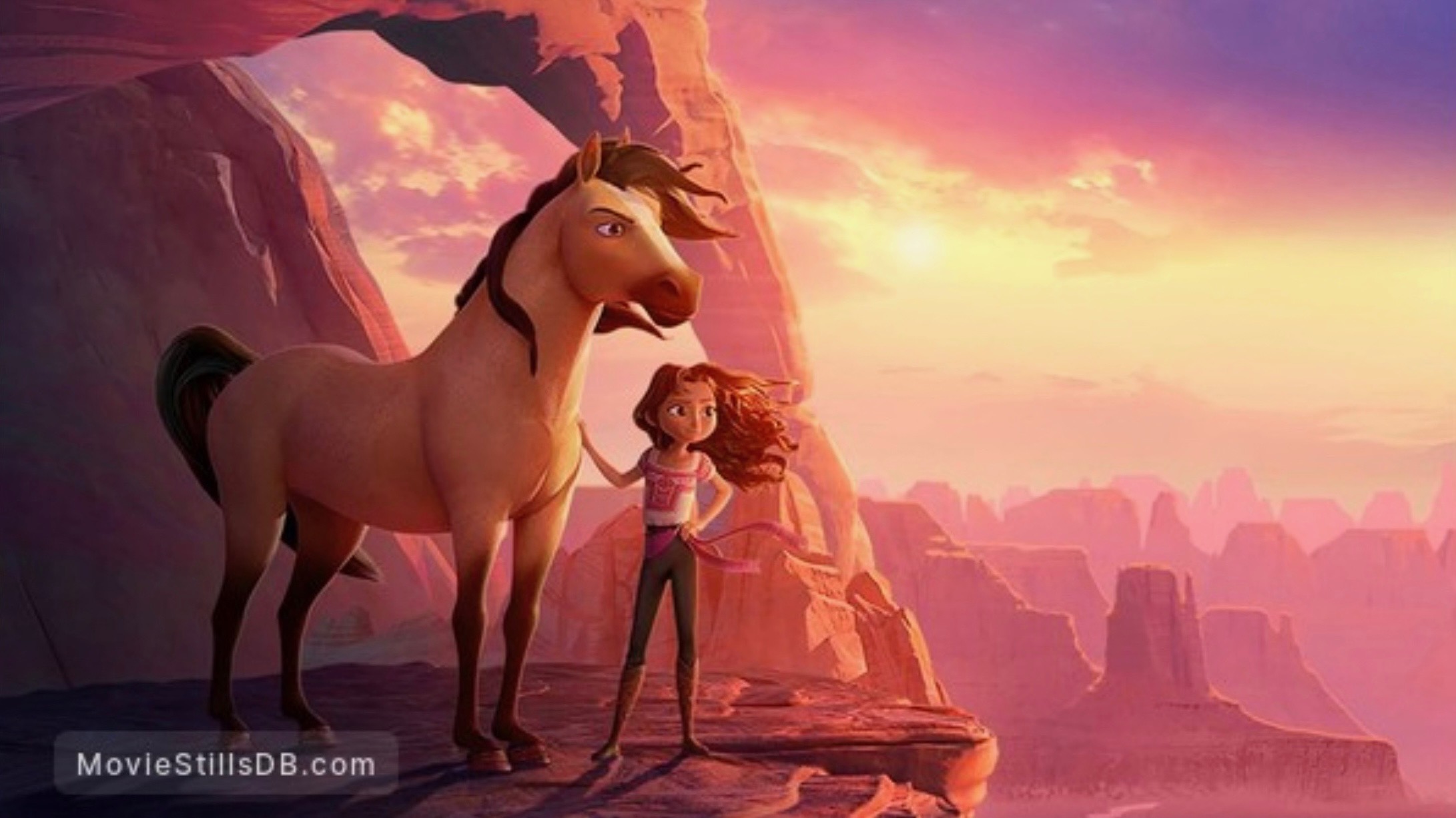
(Publicity still © DreamWorks Pictures. Source: MovieStillsDB.com. Used under editorial‑use permissions.)
Introduction
I still remember when the movie first came out. I was around 10 or 11, and after watching the original movie, “Spirit: Stallion of the Cimarron” and the spinoff series, “Spirit: Riding Free”, I was absolutely ecstatic for this next movie.
I had first fallen in love with the original movie, Spirit: Stallion of the Cimarron. I still love it to this day. Sometimes, when I go to sit down at the piano, I’ll even play a few of its legendary soundtracks.
But after having seen the two spinoffs sprouting from it, I’ve come to the conclusion that both Spirit: Riding Free and Spirit: Untamed can never hold a flame to the first movie. Not just because of the deflated and cliché plot of the two movies, but because of the propaganda and leftist ideals that felt forced into the series and movie, especially Spirit: Untamed. In my opinion, it feels as if the creators of Spirit: Untamed sacrificed the remnants of what could’ve been a decent plot to shout their message from every point possible. But let’s take a deeper look as to why.
Overview
Spirit: Untamed is centered around a girl named Lucky, and a horse subsequentially named Spirit. Lucky’s mother had been a famous horse stunt rider, and had died several years ago when Lucky was just a little girl. For years, she was sent to live with her grandfather and aunt in the city. Lucky’s father, so hurt and fearful after his wife’s death, now lives by himself on the western frontier.
Years later, Lucky is sent to live with her father for the summer. While she stays in the small town, “Miridaro”, Lucky discovers a gang of thieves and wranglers who capture a wild stallion and then his herd in order to sell them for profit. Lucky befriends the stallion and gives him a name: Spirit. She and Spirit then set off on a journey to recover his herd from the gang and set the horses free.
Thematic Elements and Positive Points
The story is largely focused on the theme of “finding where you belong” and “self-discovery”. This is highlighted in Lucky’s and Spirit’s natures; Lucky is described in the subtext, by other characters, and through her actions, as “free-spirited”, “adventurous”, “wild”, and “fearless”, even though she earns these descriptors by continually choosing to disobey her father’s direct orders to stay away from horses. Spirit is a wild horse with an unbreakable will who refuses to be broken by his captors and to let his herd be lost to the wranglers.
Lucky does show a strong commitment and loyalty to the things she loves, however. She risks her life several times to help Spirit recover his heard. And in the end, despite her previous disobedience, her relationship with her dad is restored and the two make amends.
Negative Points
Violence
Numerous characters are tossed and kicked by the horses, resulting in injury. A character at one point is hit and knocked out. One fight scene portrays a character karate kicking and punching a group of antagonists.
Wild horses relentlessly fight their captors, and many times, horses and people alike are placed in precarious life-and death situations.
While the movie does not lack action or thrill, it also does not show any details that cross the line of gore.
Language
A few slang words are aimed as insults at others, such as “dimwit”, and some characters use exclamations like “heck”.
Other
Perhaps the most prevalent negative element in the movie is the showcasing of children rebelling against their parents. Characters take extensive action to stay under the radar of their parents’ watch, even going so far as sneaking out at night and lying. One character is shown outrightly disrespecting their parent. Little to no discipline ever takes place, and in the end, some characters are actually commended for their actions of going against authority’s rule.
Analysis: Why I think Spirit: Untamed was a Thematic Flop
As I stated before, the movie’s main theme is highlighted by the actions of the “free-spirited” and “fearless” girl, Lucky. However, Lucky’s actions in the movie may not showcase the word, “fearless”, the same way Christians with a Biblical worldview would. Lucky is continually shown as a character who resists authority (i.e. her grandpa, aunt, and father) and routinely chooses to disobey direct orders from her guardians. Her heroic actions in choosing to risk her life for Spirit and his herd come with a price, and that price is direct defiance against her father’s one rule to not go near horses.
There was one thing that really bothered me was at the end, though. Although Lucky ends up apologizing to her father and admitting she was wrong, her father does not impose any consequences for her actions. On the contrary, he goes so far to nearly admit that she was right in the whole matter. Our protagonist then proceeds to get back on her horse, join up with her friends again, (who have also disobeyed their own parents) and ride off into the figurative sunset of freedom. However, I suppose that at least one credit can be given to the father of one of Lucky’s friends, when he grounds his daughter as a consequence for her actions.
The Bible clearly states that God commands children to obey their parents in the Lord (Ephesians 6:1) and promises blessings along with this command. Loving parents will always want the best for their children, and so constraints, rules, and discipline are put in place in order to help guide children. The Bible commends this, as it says in Proverbs 22:6 to, “Train up a child in the way he should go: and when he is old, he will not depart from it.”
I’m not surprised to see this agenda of defiance masked as “freedom” and “fearlessness”. But I am disappointed, and even more so to see it propagated in a children’s movie for girls. From what I have observed in much of today’s media for girls, the feminist culture runs strong in much of the content. (For more on feminism, check out my article, “The Poison of Feminism” here).
Christian parents must be careful to guard their young and tween girls against this feminist propaganda and equip them with Biblical truths that combat this poison. This discipleship, especially if it takes place earlier in the child’s life, will enable her to stand firm against the lure of the feministic siren’s call in their teens, when the pull is even stronger than it is when they are young.
Conclusion
From what I observed in the movie, it seemed to me that a storyline that could’ve been strong was sacrificed for the sake of promoting the movie’s agendas. I was a tween myself when it first came out, but it’s blatant display of defiance turned even 11-year-old me off the first time I saw it. In all honesty, I think the series, Spirit: Riding Free did a better job of promoting the same message within its storyline using subtly and symbolism. For those who remember that fad, “Girl Power”, from around 2017, it’s this critic’s opinion that Spirit: Untamed embodies that phrase just a little too well in its outward showcasing of worldly fearlessness, finding yourself, and feminism.
Leave a Reply