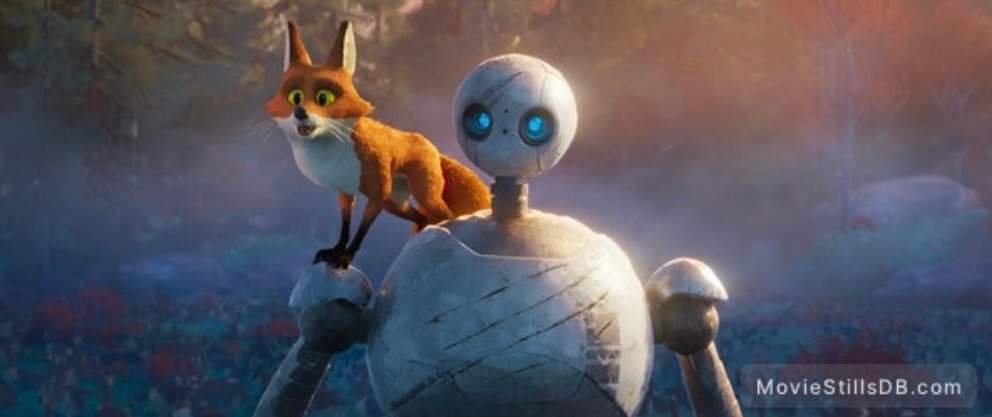
(Publicity still provided by Universal Pictures / DreamWorks Animation. Retrieved from MovieStillsDB for editorial review purposes.)
Introduction
When I first heard of The Wild Robot, it was from my peers. I was surprised at the glowing reviews I was regaled with, and the fascination which they had for this movie. But I was skeptical, to say the least. Not just because of the fact that it was supposed to be a secular children’s movie, but of the main character itself – a robot.
Now, like I’m sure more than a few people are, I’m a bit on the wary side when it comes to artificial intelligence and technology. This is especially since lately I’ve seen a surplus of media and fiction that repeatedly portrays robots capable of being able to feel like humans do. I expected The Wild Robot to do the same, and I was correct. I still do not believe it is correct to portray that artificial intelligence and robots should be able to feel as man does (discussed below). I’ve watched The Wild Robot several times, and have come to the conclusion that it is not perfect. But after all, nothing is.
I do believe that there are notable amount of positive elements, as well as negative elements, that both Christians in general and Christian parents should be aware of before they watch this movie, however.
Overview, Thematic Elements, and Positive Points
In a nutshell, The Wild Robot is about a robot stranded on an island who is forced to raise a gosling who lost its family. The story starts with a shipment of specialized “Rozum” robots who are lost in a storm and shipwrecked on an island during transportation. One of these robots largely survives the wreck and is accidentally activated. The robot, as protocol demands, then goes into the island, in search for the one who “ordered” it. In the process, it interacts with the wild creatures of the island and eventually acquires a “task” of helping a gosling orphan survive and mature in time for fall migration.
The story deals largely with themes of choosing kindness over hatred and prejudice. The theme of “survival of the fittest” is prevalent over the course of the story and is the attitude and culture of the animals of the island upon which Roz, the robot, is stranded. Roz, as the main character, serves to counter this norm in the story, ultimately bringing the island’s inhabitants to realize that, (paraphrase) “kindness is a survival skill”.
In addition to this, Roz fights to foster a sense of unity among the animals of the island, even while the animals increasingly become prejudiced against Roz and her gosling “son”, Brightbill. And finally, a third overarching theme ties it all together: facing your fears and choosing courage even against the odds. It’s a “spreading your wings” type of story (pun intended).
The Bible clearly commands us as Christians to have a kind and forgiving spirit to one another, mirroring the forgiveness and mercy God offers us via Christ’s death on the cross (Ephesians 4:32). The Wild Robot’s thematic elements reflect this principle. Roz shows the animals of the island through her own selfless actions that acting out of the interest of another brings much more benefit. She shows them that kindness is more fulfilling than simply meeting one’s own needs and wants in the name of “survival”.
Negative Elements
Shadowing this theme of courage and kindness are a few notable negative points, most of which serve to highlight the fact that we live in a broken world. Here are the biggest flags within their categories:
Violence
There are multiple near-death situations that the characters are thrust into. These mostly consist of animals chasing each other, or robotic fighting (think lasers, mechanical weapons, explosions, and fire). Many characters are thrown around or battered in a cartoon way, but for the most part, no one is seriously hurt, and no blood is ever shown.
Besides these, however, there are a few character deaths, such as the deaths of Brightbill’s family, and the death of a goose in a robot fight. However, no blood or gore is shown and the movie does not linger in the wake of their deaths very long.
Some characters suffer injuries, including Brightbill’s wing being broken near the end. Finally, one particular scene shows a robot being hooked up to a machine for a memory wipe. It may vaguely mirror a torture chamber for some, especially as the robot is surrounded by sharp tools and is operated on in a hostile environment.
Language:
Other than one use of the word, “sucked”, there is no other notable use of language in the movie.
Other:
Other notable elements include the prominent suggestion that robots have the capability of having feelings, emotions, hearts, consciousness, and the ability to love. A few animal siblings argue, fight, and pick on each other as their mother acts in an exhausted manner. Some characters laugh at others as they fall or get hit by thrown objects.
One character makes a brief comment about storytelling and lying. “Storytelling is lying adjacent. And I lie for a living!” he remarks cheerily. Another character gets bullied physically and mentally by peers, followed by an episode of outward disrespect from a character to his parent figure.
The Big Question: What about the Portrayal of Robots and AI having feelings and emotions?
Many Christians have been raising concerns lately about the rise of anthropomorphic robots – robots with feelings and emotions. But the question is, is that concern warranted? Or is this fear only an “irrational” one, shared only by hyper-conservatives or “old style” Christians?
Well, the Bible says in Genesis 1:26-27 that God created man in His own image and likeness. In addition to creating man’s physical body, God also gave him a soul and a spirit, as it says in Genesis 2:7:
And the Lord God formed man of the dust of the ground, and breathed into his nostrils the breath of life; and man became a living soul.
And Ecclesiastes 12:7:
Then shall the dust return to the earth as it was: and the spirit shall return unto God who gave it.
Because of this three part nature, man has the ability to have self-awareness and consciousness, something that animals and non-living things do not have. They have the ability to feel and know things and emotions in a way no other living thing on this earth can.
Portraying robots and artificial intelligence as being able to feel like humans do is an inaccurate representation of the way God created the universe. Of all His work, man is the crowning glory of creation, and thus has the ability to know God and experience His presence like nothing else. By stating that non-living things such as robots can have feelings and “hearts” similar to that of man implies that they also have the ability to have consciousness and self-awareness, something God has granted only to humans.
In the end, God has granted the gifts of true free will, consciousness, self-awareness, soul, and spirit to man alone. Fiction may continue to portray animals, non-living things, and yes, robots, as anthropomorphic. But we as Christians must also continue to remember that such a reality is not of God and therefore not something we should support as believers. God made man in His own image – after His own likeness. No other creation has that privilege.
Conclusion
In closing, The Wild Robot is a fun, playfully animated movie that speaks against the shadows of prejudice and hate. It features a robot as the main character, who is portrayed as capable of having emotions and anthropomorphic for the majority of the story.
Like much of today’s media, it does have a few snags. The biggest of these are cartoon violence, and the usual, “chase your heart” theme that Hollywood has so widely popularized. However, in general, any child eight years old and up should enjoy this movie just as well as adults would. I know I certainly enjoyed it.


Leave a Reply